
Search is going through its biggest shift since Google first appeared. Traditional keyword-based SEO still matters, but it is no longer enough on its own. In 2026, visibility is shaped by a combination of classic organic rankings and AI-driven discovery, Google AI Overviews, AI Mode, and large language model platforms such as ChatGPT, Claude, and Copilot.
This guide outlines a practical, data-driven framework for building an SEO and AI search strategy that actually works in 2026. The focus is not on chasing every keyword, but on prioritizing revenue-driving intent, building defensible topic clusters, and aligning content with how both search engines and AI systems retrieve information. When executed consistently, this approach compounds over time.
Step 1: Start With Google Search Console Data
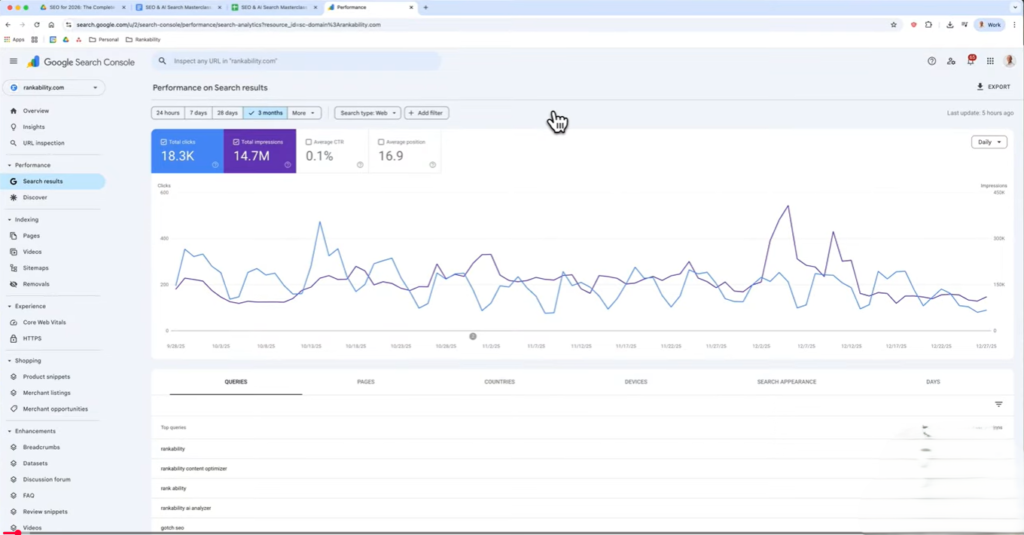
Every effective strategy starts with first-party data. Google Search Console (GSC) shows how people are already discovering your site, making it the most reliable foundation for planning.
Extracting Queries at Scale
GSC limits exports to 1,000 queries, which is often insufficient for sites with high traffic. While the API can unlock more data, a simpler workaround is to use filters.
The key is focus. Not every query deserves attention. Begin by filtering for commercial-intent keywords—queries that indicate buying, comparison, or evaluation behavior, such as:
- “best … tools”
- “top … software”
- “AI … tracking platforms.”
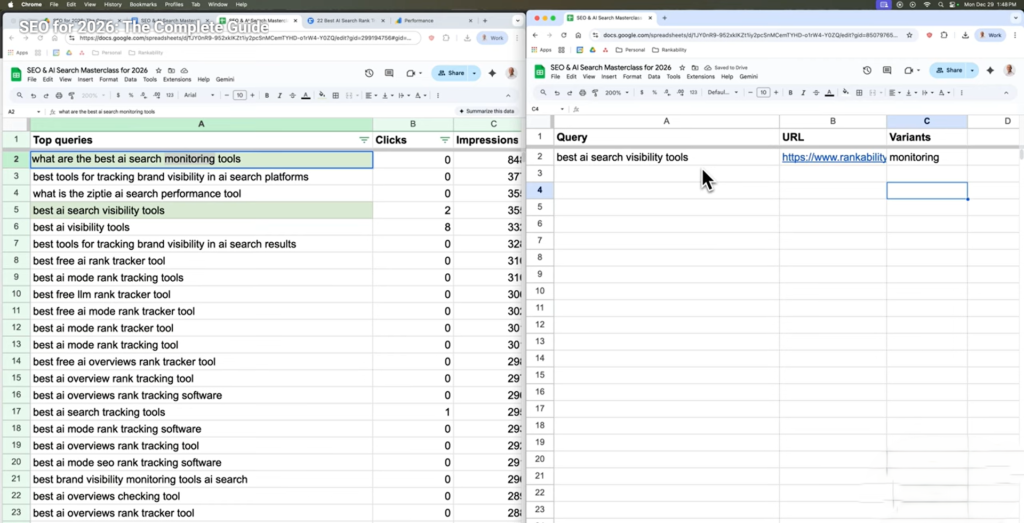
These bottom-of-the-funnel terms should guide the entire strategy. Once filtered, export the data into Google Sheets for deeper analysis.
Step 2: Identify High-Impact Pages and Keywords
Rather than trying to optimize everything at once, work in focused sprints.
A Simple Prioritization Question
Ask yourself:
Which pages and keywords would generate the most revenue if their visibility improved?
Look for a combination of:
- High-impression commercial queries
- Pages that are already ranking, but not yet winning
Pages like:
- Best SEO tools for agencies
- Best SEO content optimization tools
- Best AI search visibility tools
are often core revenue drivers. Select one primary page per sprint and build around it.
Step 3: Deep-Dive Into a Single URL
Once you’ve chosen a priority page, isolate everything Google already associates with that URL.
Page-Level Query Extraction
In GSC:
- Go to Pages
- Select the target URL
- Export the queries tied specifically to that page
This reveals how Google interprets the page today and highlights intent gaps or mismatches you can address.
Step 4: Build a Keyword Cluster Model
The strategy revolves around one core topic supported by several tightly related assets.
Classifying Keywords
Every query should fall into one of two categories:
- Same-intent variants – These belong on the existing page
- Distinct intents – These require their own dedicated pages
A practical test is simple:
If you were running paid ads for this keyword, would you need a separate landing page?
If the answer is yes, it deserves its own page.
Example
Core topic: AI search visibility tracking tools
Include on the main page:
- AI search monitoring tools
- AI search platforms
Create separate pages for:
- Best AEO tracking tools
- Best AI Mode rank tracking tools
- AI search tools for Google AI Mode
Most strong clusters end up with five to ten closely related pages.
Step 5: Validate Intent With SERP Analysis
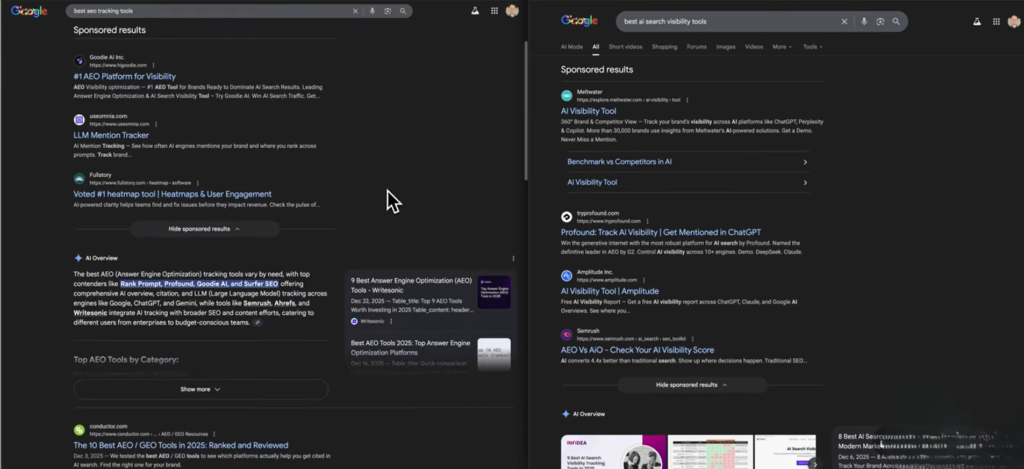
Before creating new content, confirm intent directly in Google.
Compare:
- The target query SERP
- The core keyword SERP
If the top organic results differ significantly, Google sees these as separate intents—confirming the need for a dedicated page.
Ignore AI Overviews during this step and focus on traditional organic results to avoid noise.
Step 6: Build a Brand Knowledge Base
A structured knowledge base is no longer optional—it is foundational for AI visibility.
Why This Matters
AI systems rely on retrieval. Without consistent, authoritative brand information, AI-generated references become generic, inaccurate, or off-brand.
What to Include
- Product and feature documentation
- Service descriptions
- Reviews and testimonials
- Brand messaging and positioning
- FAQs and internal SOPs
How to Implement
This can live in:
- ChatGPT Projects with uploaded brand files
- Custom retrieval systems
- Platforms with built-in knowledge base tooling
The goal is simple: ensure every AI-assisted output is accurate, consistent, and grounded in facts.
Step 7: Optimize Existing Pages First
Before publishing new content, strengthen what already exists.
Technical Fundamentals
Confirm that the page:
- Is crawlable and indexable
- Is not blocked by robots.txt or meta tags
- Appears in a site: search
- Is accessible to AI crawlers
On-Page Basics
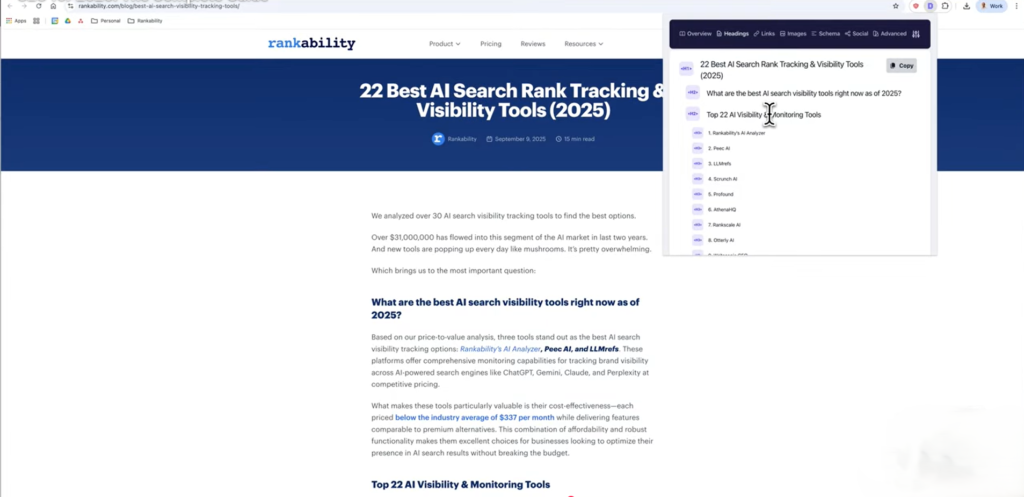
Ensure the primary keyword appears naturally in:
- Title tag
- Meta description
- H1
- Supporting H2s
If these fundamentals are already solid, future gains will come from depth, clarity, and relevance—not keyword repetition.
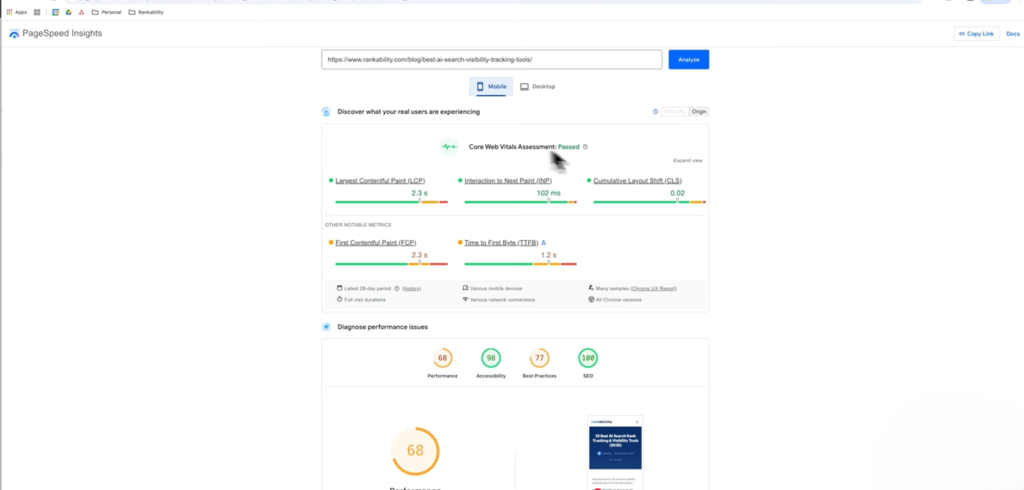
Step 8: Evaluate Performance and Speed
Page speed matters, but only in context.
For most B2B sites:
- Desktop performance often matters more than mobile
- A mobile score around 70 is usually sufficient
Avoid chasing marginal gains. Optimize speed only when it meaningfully improves user experience or conversions.
Step 9: Run a Competitive Content Gap Analysis
Use content comparison tools to identify:
- Topics competitors cover that you do not
- Missing concepts or entities
Common gaps often include:
- Specific AI models
- Platform-level tracking (ChatGPT, Claude, Copilot)
- New or emerging AI search features
These gaps represent opportunities to strengthen topical authority. Keep in mind that optimization is not permanent—content must evolve as competitors do.
Step 10: Perform a Link and Authority Reality Check
In competitive SERPs, links still matter.
Evaluate:
- Your domain authority relative to competitors
- Referring domains to ranking pages
If competitors are significantly stronger, on-page improvements alone will not close the gap. Authority building must be part of the strategy.
Step 11: Improve Internal Linking and Site Architecture
Run a focused crawl to assess:
- Crawl depth
- Internal link volume
- Contextual relevance of links
Key principles:
- Priority pages should be no more than one to two clicks from the homepage
- Strong internal linking accelerates authority flow
Even excellent content can underperform if it is buried too deeply.
Step 12: Create Supporting Assets Strategically
Once the primary page is upgraded:
- Publish supporting pages
- Internally link them to the core asset
- Target long-tail, high-intent queries
This delivers three benefits:
- Increased topical authority
- Additional conversion-ready traffic
- Fresh data to expand the cluster further
Each new page becomes an input for future optimization.
Step 13: Use AI Carefully for Competitive Keywords
AI-generated content can perform, but risk increases as competition rises.
General guidelines:
- Low to mid-competition keywords: AI-assisted content works well
- High-competition keywords: Human-led content with AI support is safer
AI should enhance research, structure, and consistency—not replace subject-matter expertise.
Step 14: Exploit Emerging AI Search Gaps
Many AI-specific queries still lack focused content.
Examples include:
- AI Mode rank tracking
- Claude or Copilot visibility tools
When SERPs look broad or unfocused, that signals opportunity. Purpose-built pages can rank quickly and establish early authority.
Conclusion
A winning SEO and AI search strategy in 2026 is not about chasing every trend or mass-producing content. It is about:
- Using real performance data
- Prioritizing revenue-driving intent
- Building focused, defensible topic clusters
- Supporting content with authority and internal structure
- Aligning with how search engines and AI systems retrieve information
By executing this system consistently, one cluster at a time, you create compounding visibility across traditional search and AI-powered platforms, while building a scalable and durable organic growth engine.
Insights from SEO Expert Nathan Gotch
This approach reflects best practices outlined by the co-founder and CEO of Rankability, an AI SEO software platform, Nathan Gotch, who emphasizes data-driven decisions and strategic content clustering for sustainable growth.